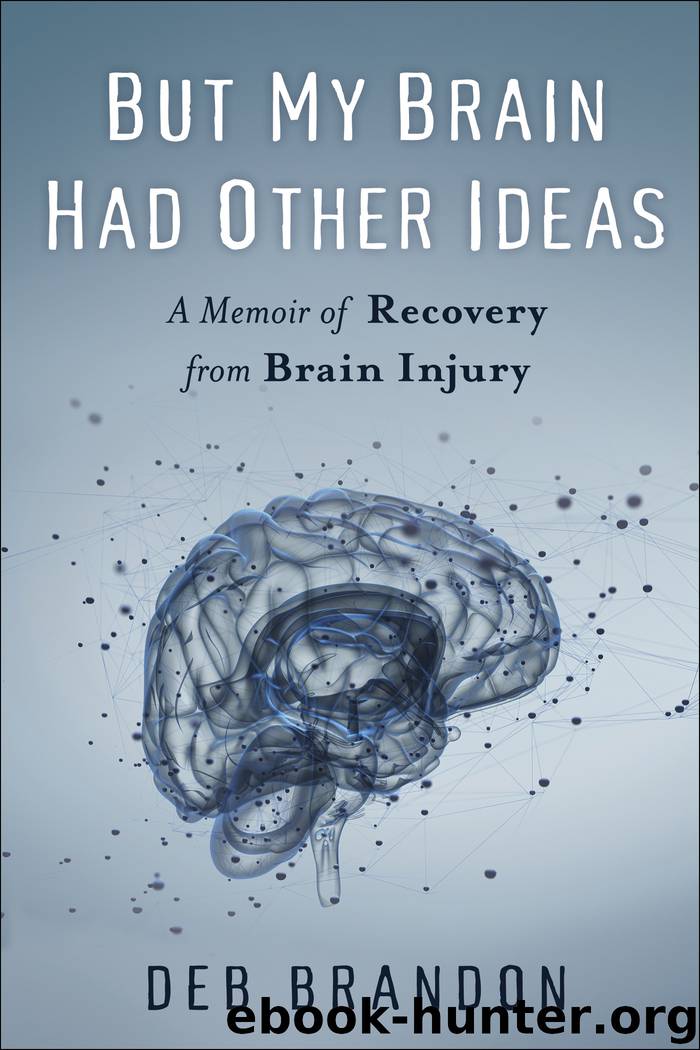
But My Brain Had Other Ideas by Deb Brandon
Author:Deb Brandon
Language: eng
Format: epub
Publisher: She Writes Press
Published: 2017-12-22T16:00:00+00:00
chapter seventeen
Fall and Winter 2007: Discoveries
I’D BEEN ON THE PHONE TO CINDY, ALL TOO FREQUENTLY sobbing, every day since I’d been discharged from the hospital. Two or three daily bouts of crying was the norm.
I blubbered over the numerous mistakes I made as I warped my loom, I wept over my difficulties remembering a particular knitting technique, and I cried when I was too tired to watch a movie with my kids.
Many of my tears were over trivialities that would have been mild irritants in the past: a leaky milk carton, a lost pencil, a wet towel left crumpled on the carpet.
About a month after I returned home, Cindy finally spoke up. “Your moods are all over the place. Have you talked to your therapist about it? I think you need meds.”
I was shocked. The possibility of going on psychiatric medication had not occurred to me. I wasn’t like my cousin whose mother died when she was ten years old, or my friend who had been suicidal at various points in his life, or my student who was bipolar—they had major issues. Whereas I . . . I’d just had brain surgery. It wasn’t the same. I wasn’t depressed; I just got really upset a little too easily. I was just fragile, and, given what I’d been through, that was quite understandable.
I certainly wasn’t in denial over my emotional state. Even barely out of the hospital, when everything had been new and unfamiliar, I’d realized that I needed help. Not only had I been honest with myself about my extreme vulnerability, I’d even anticipated problems due to my deteriorating relationship with my husband. I’d been proactive—I’d started seeing a psychotherapist regularly within days of my return home from Arizona.
I had the situation well in hand.
I had read in a couple of books that brain injury survivors often suffer from biological depression, depression triggered by chemical imbalances caused by the brain injury. In one, I read about a patient who lamented not having gone on antidepressants sooner. Feeling fortunate that I wasn’t in that bad shape, I sympathized with those who were.
I didn’t need meds.
Over the next few weeks, Cindy grew more insistent. I continued to resist, telling her that I was fine, elaborating on the sources of my frustrations, explaining away my vulnerabilities, blaming really bad days on normal hormonal changes within my menstrual cycle.
But as the tears fell more frequently and flowed more freely, I had more trouble rationalizing.
I finally sank into the abyss. I spent a couple of weeks feeling desolate, hopeless. Suicide seemed like a logical solution, a way to bring an end to the misery, perhaps the only way.
Not wanting Cindy to try to talk me out of it, I broke my promise to her—I didn’t tell her about my suicidal thoughts. I also kept them secret from my therapist for the same reason.
Later, when the worst was over, I kept my silence because I felt ashamed, and later still, I added guilt to the shame—I had betrayed Cindy’s trust.
Download
This site does not store any files on its server. We only index and link to content provided by other sites. Please contact the content providers to delete copyright contents if any and email us, we'll remove relevant links or contents immediately.
Inner Engineering: A Yogi's Guide to Joy by Sadhguru(6796)
The Power of Now: A Guide to Spiritual Enlightenment by Eckhart Tolle(5783)
Fear by Osho(4740)
Ikigai by Héctor García & Francesc Miralles(4274)
The Art of Happiness by The Dalai Lama(4130)
The Ultimate Bodybuilding Cookbook by Kendall Lou Schmidt(3945)
Yoga Therapy by Mark Stephens(3749)
The Little Book of Hygge by Meik Wiking(3694)
The Healing Self by Deepak Chopra(3580)
Why Buddhism is True by Robert Wright(3454)
The Hatha Yoga Pradipika (Translated) by Svatmarama(3342)
Being Aware of Being Aware by Rupert Spira(3276)
Shift into Freedom by Loch Kelly(3199)
Wild Words from Wild Women by Stephens Autumn(3153)
Work Clean by Dan Charnas(3123)
Happiness by Matthieu Ricard(3050)
More Language of Letting Go: 366 New Daily Meditations by Melody Beattie(3030)
Yoga Body & Mind Handbook by Jasmine Tarkeshi(2880)
Why I Am Not a Feminist by Jessa Crispin(2760)
